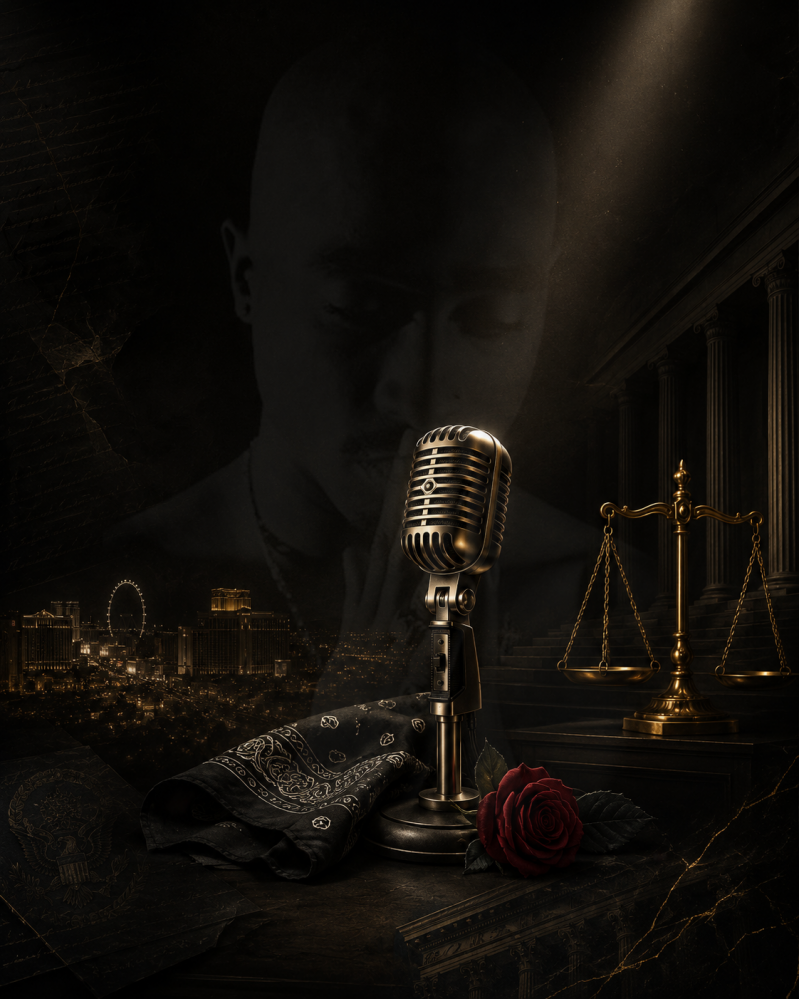
From the 1996 casino confrontation to the confessions that reopened a cold case, the Tupac Shakur murder trial has finally produced its first conviction.
Nearly 30 years after Tupac Amaru Shakur was fatally shot on the Las Vegas Strip, a jury has delivered a historic verdict.
On August 31, 2026, a Clark County jury found Duane “Keffe D” Davis guilty of first-degree murder with the use of a deadly weapon for orchestrating the 1996 attack. The jury deliberated for less than three hours following an 11-day trial—bringing the first conviction ever secured in one of hip-hop’s most infamous murder cases. Davis now faces the possibility of life in prison, with sentencing scheduled for October 13, 2026.
The verdict answers one major legal question: Was Davis criminally responsible for Tupac’s death even if he did not fire the fatal shots?
The jury’s answer was yes.
The Night Everything Changed
On September 7, 1996, Tupac attended the Mike Tyson–Bruce Seldon fight at the MGM Grand in Las Vegas with Death Row Records co-founder Marion “Suge” Knight and members of their entourage.
After the fight, Tupac, Knight and several associates became involved in a casino confrontation with Orlando “Baby Lane” Anderson, a reputed member of the South Side Compton Crips and Davis’ nephew. Surveillance footage captured Tupac and members of the entourage attacking Anderson inside the MGM Grand.
Prosecutors argued that the beating became the motive for what happened next.
According to the state’s case, Davis gathered Anderson, DeAndre “Dre” Smith and Terrence “T-Brown” Brown after the confrontation. The four men allegedly obtained a firearm, entered a white Cadillac and began searching Las Vegas for Tupac and Knight.
Later that night, Tupac was seated in the passenger side of a black BMW driven by Knight when the white Cadillac pulled alongside them near Flamingo Road and Koval Lane.
Gunfire erupted from the Cadillac.
Tupac was struck four times, suffering wounds to his chest, arm and thigh. Knight was injured by bullet fragments but survived. Tupac was transported to University Medical Center, where he remained in critical condition before dying on September 13, 1996. He was only 25 years old.
A Case That Went Cold
Despite the enormous attention surrounding Tupac’s murder, no one was immediately arrested.
The investigation was complicated by strained relationships between police departments, distrust of law enforcement, reluctant witnesses, gang politics and the growing mythology surrounding the East Coast–West Coast rap conflict.
Anderson was widely identified by investigators as a possible gunman, but he denied involvement and was never charged. He was killed in an unrelated Compton shooting in 1998.
The other two men believed to have occupied the Cadillac—Smith and Brown—also died before prosecutors brought the case to trial. Davis eventually became the only surviving alleged occupant of the vehicle and the only person ever formally charged in Tupac’s murder.
For decades, the case remained officially unsolved while theories spread throughout hip-hop culture. Those theories implicated numerous artists, executives and organizations, but speculation was not the same as admissible evidence.
The case against Davis would ultimately be built largely from something unexpected: his own words.
The Confessions That Changed the Case
Over the years, Davis repeatedly discussed the shooting in interviews, documentaries, private conversations and his 2019 memoir, Compton Street Legend.
He acknowledged being in the front passenger seat of the Cadillac and described how the firearm allegedly made its way to the passengers in the back seat. He also spoke about the anger surrounding the attack on his nephew and the search for Tupac and Knight following the casino fight.
Investigators said those public statements revived the long-dormant case.
In July 2023, Las Vegas police executed a search warrant at a Henderson, Nevada, home connected to Davis. On September 29, 2023—27 years after Tupac’s death—Davis was arrested and indicted for murder with the use of a deadly weapon.
He pleaded not guilty.
The prosecution did not claim that Davis personally fired the shots. Instead, it alleged that he procured the gun, supplied it to the group and directed the retaliation.
Under Nevada law, someone who knowingly aids, encourages or facilitates a murder may be held legally responsible for the killing even if another person pulls the trigger.
The Trial Begins
After multiple delays, jury selection began on August 10, 2026, in Clark County District Court. Opening statements followed on August 17.
Chief Deputy District Attorney Binu Palal told jurors that Davis had acted as the group’s “shot caller.” Prosecutors argued that the MGM Grand assault created an immediate demand for retaliation within the gang culture Davis described in his own interviews.
The state presented approximately two dozen witnesses and played recordings in which Davis repeatedly recounted his alleged role in the events surrounding the shooting.
The prosecution’s position was straightforward: Davis had admitted being inside the Cadillac, admitted helping obtain or distribute the gun and repeatedly explained why the group went looking for Tupac.
He did not need to be the shooter to be guilty of murder.
The Defense: His Stories Were Not Reliable
Defense attorney Michael Sanft attacked the reliability of Davis’ previous statements.
The defense argued that Davis had exaggerated or fabricated details to gain attention, promote his memoir and make money from a story that had fascinated the public for decades. Sanft characterized the police investigation as biased and poorly handled, arguing that investigators had eventually targeted a man known to embellish stories.
The defense also emphasized the case’s evidentiary weaknesses:
- No murder weapon was produced at trial.
- There was no DNA or fingerprint evidence connecting Davis to the shooting.
- The exact identity of the gunman remained disputed.
- Several alleged participants and crucial witnesses were already dead.
- Much of the prosecution’s case depended upon Davis’ own changing accounts.
Davis disavowed his earlier statements, maintaining that portions of the story had been fictionalized or sensationalized.
That placed one central question before the jury: Were Davis’ repeated accounts merely entertainment—or were they admissions from a man who believed he would never face prosecution?
Closing Arguments and the Verdict
On August 31, prosecutors and the defense delivered their closing arguments.
The state urged jurors to consider the consistency and level of detail in Davis’ numerous statements. Prosecutors argued that he repeatedly placed himself inside the vehicle, described the motive and explained how the weapon reached the back seat.
The defense maintained that the government had failed to support those statements with sufficient physical evidence and warned jurors against convicting someone on the basis of stories told decades later.
After deliberating for less than three hours, the jury returned its decision:
Guilty of first-degree murder with the use of a deadly weapon.
Davis remained standing beside his attorney as the verdict was announced before sitting with his hands clasped on the defense table. Tupac’s sister, Sekyiwa “Set” Shakur, was visibly emotional and embraced members of the prosecution team following the decision.
Davis’ defense has indicated that it plans to appeal.
What the Verdict Does—and Does Not—Establish
The conviction legally establishes that Davis participated in and orchestrated the retaliatory plan that resulted in Tupac’s death.
However, the trial did not definitively resolve every question surrounding the shooting. Most significantly, the jury was not required to determine whether Anderson or Smith fired the weapon. Prosecutors only had to prove beyond a reasonable doubt that Davis knowingly assisted or facilitated the murder.
The verdict also does not validate every conspiracy theory that has circulated since 1996. No other music executive, artist or record company was placed on trial in this case.
This was the State of Nevada’s case against Duane Davis—and the jury found him guilty.
Final Verdict, but Sentencing Still Ahead
The final trial verdict is guilty, but the judicial process is not completely over.
Judge Carli Kierny scheduled Davis’ sentencing for October 13, 2026. He could receive life in prison, potentially without the possibility of parole. His expected appeal could also keep the case active for years.
Still, the conviction represents something Tupac’s family, supporters and generations of hip-hop fans waited nearly three decades to see: someone held criminally accountable for the attack.
Tupac’s life cannot be reduced to the way it ended. He was a poet, actor, activist and cultural force whose work confronted racism, poverty, violence, police brutality, vulnerability and survival. His voice remains present because his music was never simply entertainment—it was testimony.
Thirty years after the gunfire on the Las Vegas Strip, a jury finally rendered its judgment.
Duane “Keffe D” Davis did not have to pull the trigger to be held responsible for Tupac Shakur’s murder. According to the verdict, he helped set the killing in motion.
And after decades of rumors, failed investigations and unanswered questions, that distinction became the foundation of the case that finally secured a conviction.
Add comment
Comments